
Hitachi Digital launches HARC Compose to govern agentic engineering
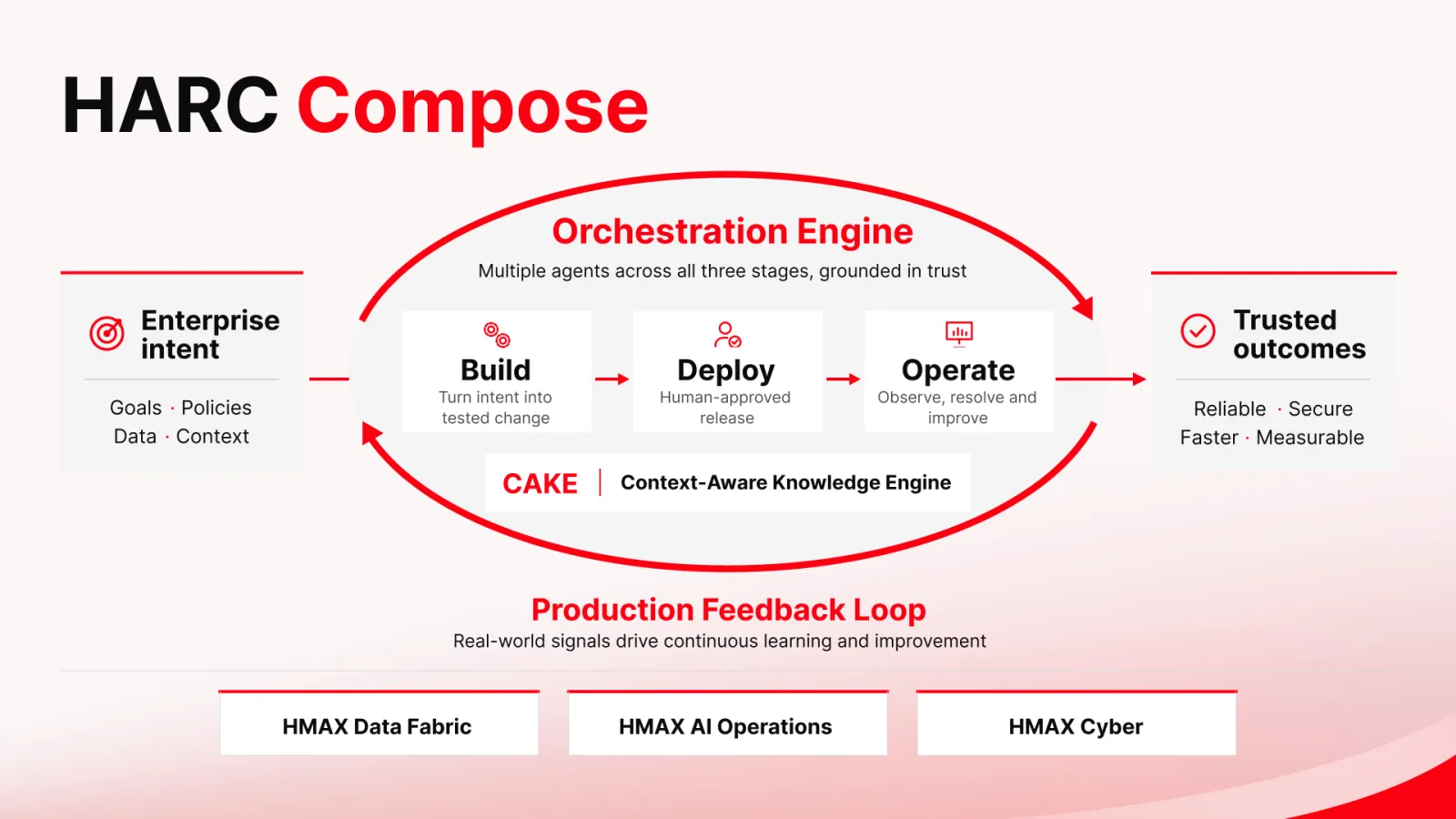
Hitachi Digital, the global digital services company formed from the merger of GlobalLogic and Hitachi Digital Services, has launched HARC Compose: a unified platform designed to govern the full lifecycle of AI-generated software inside complex enterprise environments. The product targets a problem that has grown quietly alongside the generative-AI coding boom: writing code faster is no longer the constraint. Keeping it trustworthy once it is running inside a bank's payment rail or a hospital's patient-management system is.
The release lands as enterprises across finance, healthcare, and enterprise technology confront a structural gap. AI coding assistants have compressed development timelines significantly, but the same speed that accelerates delivery also accelerates the propagation of untested assumptions into production systems. HARC Compose is positioned as the governance layer that sits between the AI agent generating the code and the live systems on which it eventually runs, carrying what Hitachi Digital calls "enterprise intent" through each stage of the build, deploy, and operate cycle.
Closing the loop between build and run
At the product's core is CAKE, the Context-Aware Knowledge Engine, which feeds enterprise policies, risk rules, domain knowledge, and production history into AI agents before they act. The idea is to prevent what the company characterises as "fast failure": situations where code that passes synthetic tests breaks real-world workflows because the agent lacked the institutional context a human engineer would have absorbed over time. Alongside CAKE, an Orchestration Engine coordinates multiple agents across a multi-vendor environment, meaning enterprises can adopt the platform in full or selectively bolt it onto existing toolchains without replacing current development infrastructure.
A further component, described as failure-conscious engineering, draws on failure mode and effects analysis (FMEA), a methodology more familiar in aerospace and automotive manufacturing than in software. Teams map potential failure modes before a change ships, translating those into automated tests and recovery strategies. After release, the system checks live production data against the intended outcome, and human engineers retain sign-off authority over anything that goes live. "The true promise of AI isn't just writing code faster," said Anand Birje, CEO and Chairman of Hitachi Digital. "It is shifting human ingenuity toward composing resilient, mission-critical systems."
Cross-sector stakes in agentic software governance
The strategic significance of HARC Compose stretches beyond the software delivery niche. As agentic AI systems move from productivity experiments into regulated infrastructure, the question of who governs AI-generated change in mission-critical environments is becoming a capital-allocation question as much as an engineering one. Financial services regulators in the UK, EU, and US are already scrutinising model risk management frameworks; healthcare systems integrating AI into clinical workflows face comparable audit and liability pressures. Any enterprise platform that credibly addresses the governance gap in these two verticals simultaneously is operating at a compelling intersection of regulatory risk and procurement budgets.
For Hitachi Digital specifically, the product deepens a recurring-services revenue model: the company's forward-deployed engineers (approximately 35,000 professionals across 27 countries) use HARC Compose as the operational scaffolding for ongoing client engagements, rather than handing off a tool and exiting. This structure resembles the managed-services model that consultancies such as Accenture and IBM have long used, but applied specifically to agentic AI maintenance rather than legacy system integration. As enterprise AI moves from pilot to production at scale, the governance and operations layer is likely to attract both venture and corporate investment: rivals including ServiceNow, Palantir, and a cohort of well-funded MLOps startups are approaching the same problem from different angles. Hitachi Digital's differentiation rests on deep sector relationships in infrastructure-adjacent industries and the institutional credibility of its parent's industrial heritage. Whether that is sufficient to establish category leadership in agentic software governance will become clearer as early finance and healthcare deployments mature into case studies.