
SKYX and Deako merge to target smart home builder and hotel markets
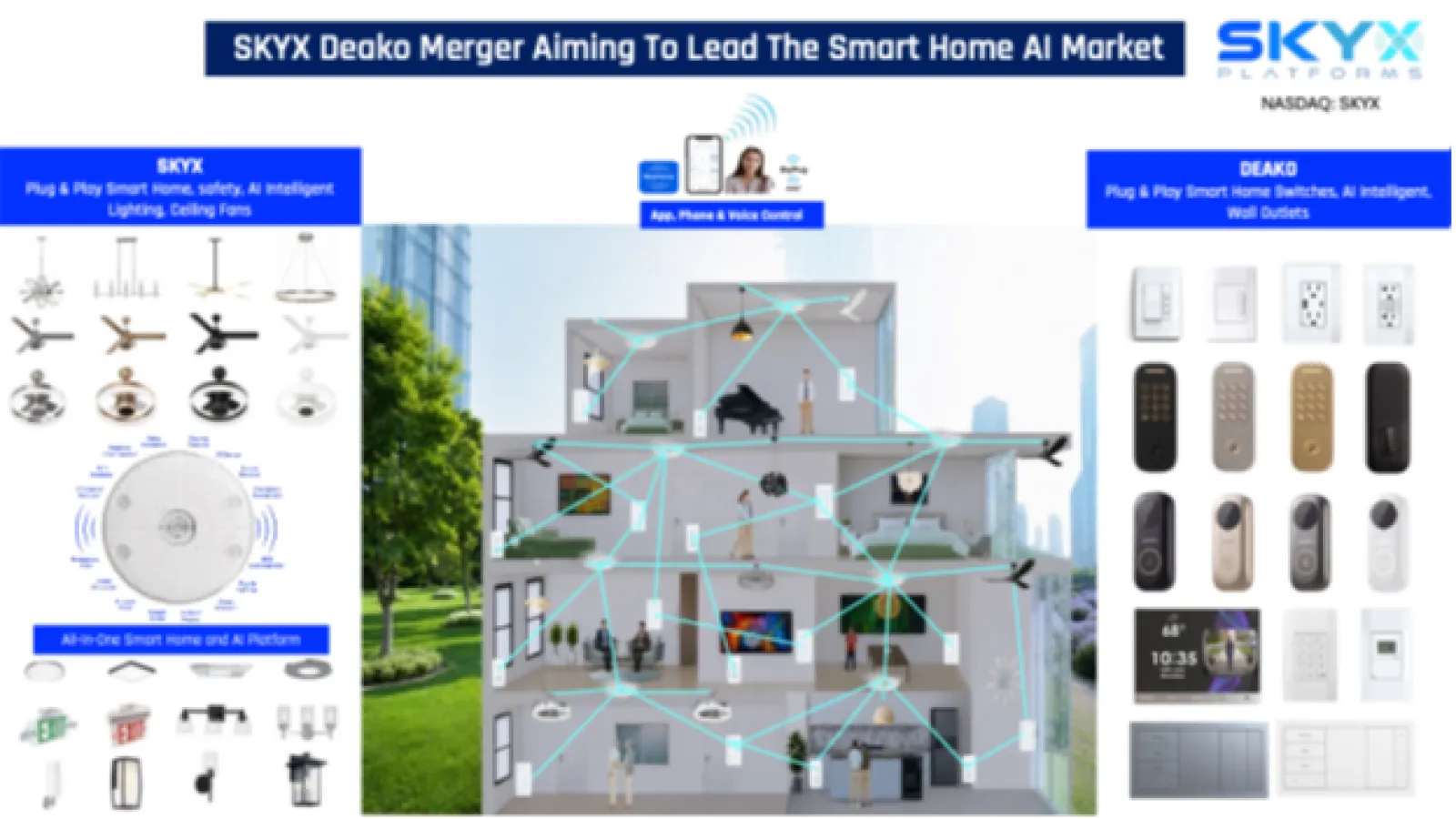
SKYX Platforms Corp (NASDAQ: SKYX), the Miami-based smart home infrastructure company, has signed a merger agreement with Deako Inc., a Silicon Valley-backed intelligent lighting and wall-switch platform supplier. The combined entity aims to deliver what both companies describe as a full "A-to-Z" plug-and-play solution for the electrical infrastructure inside homes, commercial buildings and hotels, a convergence of consumer IoT hardware, AI-enabled building management, and the US residential construction supply chain.
Deako shipped more than 32 million units over the past five years and recorded revenues of over $26 million in 2025. The company counts more than 50 US homebuilders among its clients, including D.R. Horton and Toll Brothers, the two largest residential builders in the country by volume. SKYX, for its part, holds over 100 US and global patents and has secured approvals from the National Fire Protection Association's National Electrical Code (NFPA-NEC) across ten segments, as well as a standards vote from ANSI/NEMA, giving it a regulatory foothold that is difficult for smaller rivals to replicate quickly.
A platform play across the built environment
The deal is structured as an all-stock transaction. SKYX will issue 25 million new shares, representing 18.46% of the enlarged company, to Deako shareholders and lenders under a two-year lock-up arrangement. SKYX will also pay Deako's lender $4 million at closing, then $2.25 million in Q1 2027 and a further $6.25 million in Q4 2027. Post-merger, existing SKYX shareholders will hold 84.4% of the combined group. The deal expands the joint patent portfolio to more than 120 applications spanning plug-and-play hardware, AI services and smart home platforms.
The strategic rationale is distribution. SKYX has technology and building-code credentials but limited penetration into the new-build residential channel. Deako has the builder relationships but not the ceiling-mounted hub, the AI platform layer, or the hotel-sector footholds SKYX has cultivated, including a cited relationship with Marriott and involvement in a $4 billion Miami smart-city project. Deako's CEO Derek Richardson, a former sales executive at BlackBerry and Cypress Semiconductor, will lead commercial growth for the merged group.
Deako's board includes Paul Jacobs, former chairman and CEO of Qualcomm, and Marwan Fawaz, former CEO of Nest. Jacobs framed the deal in ecosystem terms: "Together they provide the electronic real estate of homes, buildings and hotels, where power, control, sensing and AI intelligence will naturally live."
Convergence angle: real estate meets IoT infrastructure
The broader significance sits at the intersection of three sectors that rarely move together. The US homebuilding industry is under structural pressure to reduce on-site labour time and differentiate on technology features as affordability constraints squeeze buyer demand. Plug-and-play smart home infrastructure, standardised, code-compliant, and installable without specialist electricians, addresses both pressures simultaneously. For builders such as D.R. Horton, which operates at high volume across entry-level price points, reducing wiring complexity has a direct impact on construction margins.
For investors tracking the smart-home and IoT landscape, the SKYX-Deako merger signals a maturation dynamic: rather than competing platform-to-platform in a fragmented consumer market, the winning bet appears to be vertical integration into the construction supply chain, locking in specification at the point a house is built rather than retrofitting later. This mirrors a broader capital trend visible in adjacent sectors, smart-grid hardware companies embedding themselves in utility procurement, and proptech platforms seeking distribution via developer relationships rather than direct-to-consumer channels.
The hotel angle adds a further dimension. Hospitality operators are under sustained pressure to reduce energy costs and meet ESG reporting requirements, and AI-enabled room-level switching and sensing infrastructure offers a measurable path to both. If SKYX can leverage Deako's builder credibility to accelerate hotel specification cycles, the recurring-revenue model from subscriptions and AI monitoring services becomes materially more credible. The merger's medium-term test will be whether those recurring streams materialise before the promissory note repayments of late 2027 create balance-sheet strain for what remains a small-cap, pre-profitability business.