
TAQA lifts H1 profit 10% as Gulf utility pivots from oil to renewables
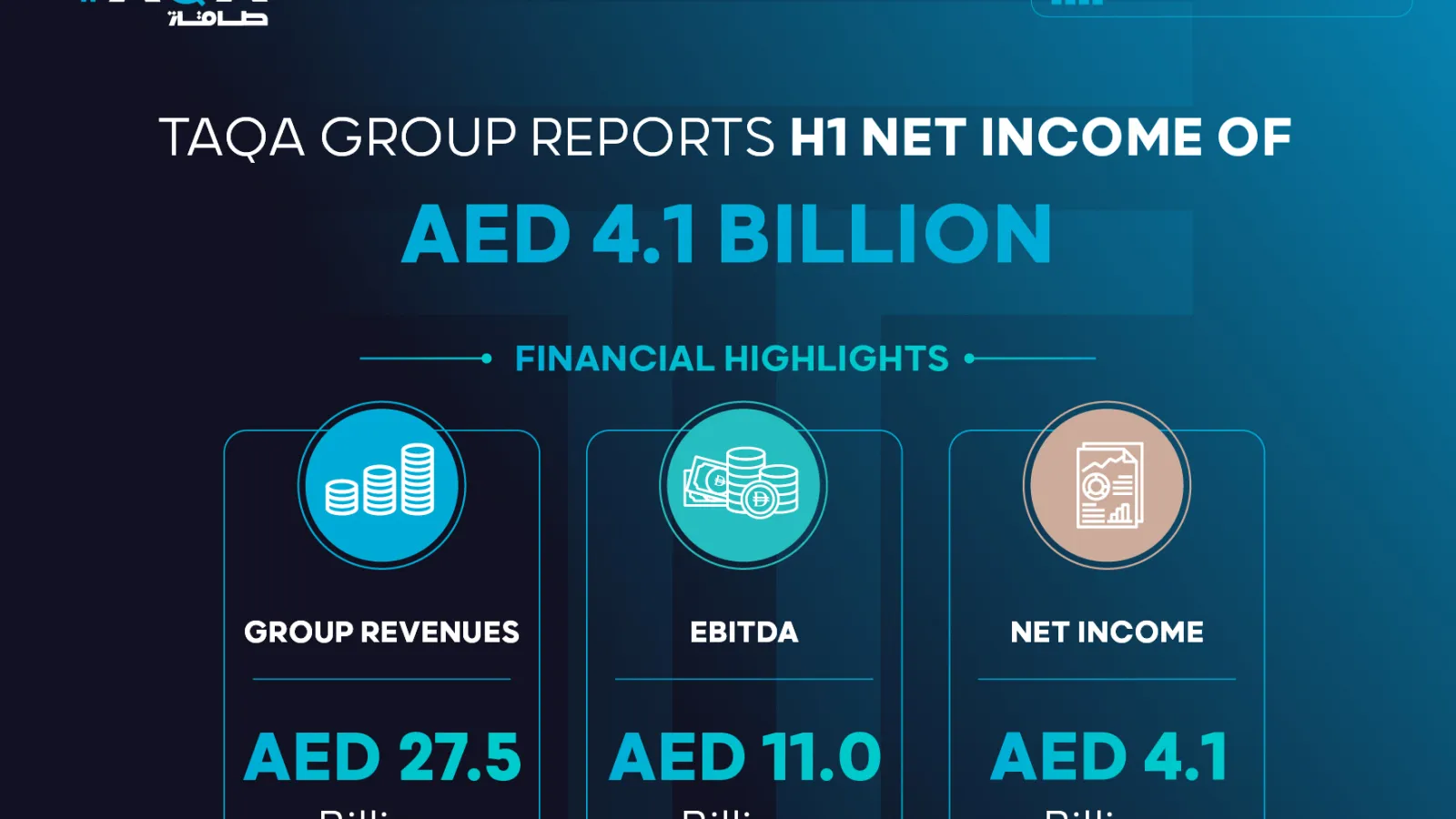
Abu Dhabi National Energy Company (TAQA) has reported a 9.7% rise in net income attributable to shareholders to AED 4.1 billion for the first half of 2026, even as group revenues slipped 2.6% to AED 27.5 billion. The divergence tells the strategic story: planned decommissioning of UK North Sea oil and gas assets is compressing the upstream line, while the utilities core, transmission, generation, and water, is expanding fast enough to absorb the shortfall and then some. EBITDA rose 7.7% year-on-year to AED 11.0 billion.
The headline number that should attract attention from capital allocators is capital expenditure, which jumped 38% year-on-year to AED 7.2 billion. Free cash flow fell to AED 4.6 billion from AED 7.0 billion in the prior-year period, a direct consequence of that investment acceleration rather than any operational deterioration. The board approved a Q2 interim dividend of 0.8 fils per share, worth approximately AED 899 million, signalling confidence in the underlying earnings trajectory.
Infrastructure deals anchoring Abu Dhabi's industrial ambitions
The results were accompanied by a clutch of long-term infrastructure commitments that illustrate how TAQA is positioning itself as the utility backbone for Abu Dhabi's broader economic diversification agenda. A consortium led by TAQA with a 60% stake won the 2.6 GW Taweelah C Independent Power Producer contract from Emirates Water and Electricity Company (EWEC), designed to support grid stability through to 2050 while accommodating the large-scale integration of renewables. Separately, a 27-year Utilities Purchase Agreement with national oil company ADNOC will supply critical utilities to the TA'ZIZ Industrial Chemicals Zone in Ruwais, tying TAQA's fortunes directly to Abu Dhabi's downstream petrochemicals build-out. A long-term wastewater treatment deal for Ras Al Khaimah, at 60,000 cubic metres per day and serving up to 300,000 people, extends TAQA's municipal infrastructure footprint beyond Abu Dhabi.
On the financing side, TAQA, EWEC, Masdar, EDF Power Solutions, and Jinko Power completed a USD 870.75 million green bond issuance to refinance the Al Dhafra Solar PV plant, demonstrating that Gulf sovereign utilities can access international sustainable-debt markets at scale. Jasim Husain Thabet, Group CEO and Managing Director, said the company's integrated model "gives us the stability and financial strength to keep investing in the power and water infrastructure needed for decades to come."
Masdar as the international renewables vehicle
The cross-sector and geopolitical significance of this set of results extends well beyond the UAE. TAQA holds a leading stake in Masdar, Abu Dhabi's clean-energy champion, and Masdar's deal activity in H1 2026 reads as a sovereign capital offensive across three continents. A USD 2.2 billion joint venture with TotalEnergies targets onshore renewables across Asia; a deal with Repsol acquires a 49.99% stake in a EUR 849 million, 705 MW operational renewables portfolio in Spain with potential for a further 565 MW of hybridisation; and 3 GW of new offshore wind capacity was secured through Contracts for Difference in the UK's Dogger Bank South projects.
Read together, these moves represent a deliberate deployment of Gulf sovereign capital into European and Asian energy infrastructure at a moment when both regions are competing for clean-power investment and grappling with energy security after years of supply-chain disruption. For cross-sector investors, TAQA's model is worth watching as a template: a state-backed utility that is simultaneously building domestic industrial utility infrastructure, retiring fossil-fuel assets in legacy Western markets, and using a specialist vehicle (Masdar) to plant flags in renewable capacity across multiple regulatory regimes. The question for the second half of 2026 is whether the 38% capex surge can be sustained without further free-cash-flow compression, and how quickly the Taweelah C and Ruwais utility agreements begin contributing to EBITDA. The green bond market's appetite for Gulf sovereign-backed paper will be a useful leading indicator.