
Holtec, Entergy and Hyundai E&C target SMR-300 rollout in US Gulf South
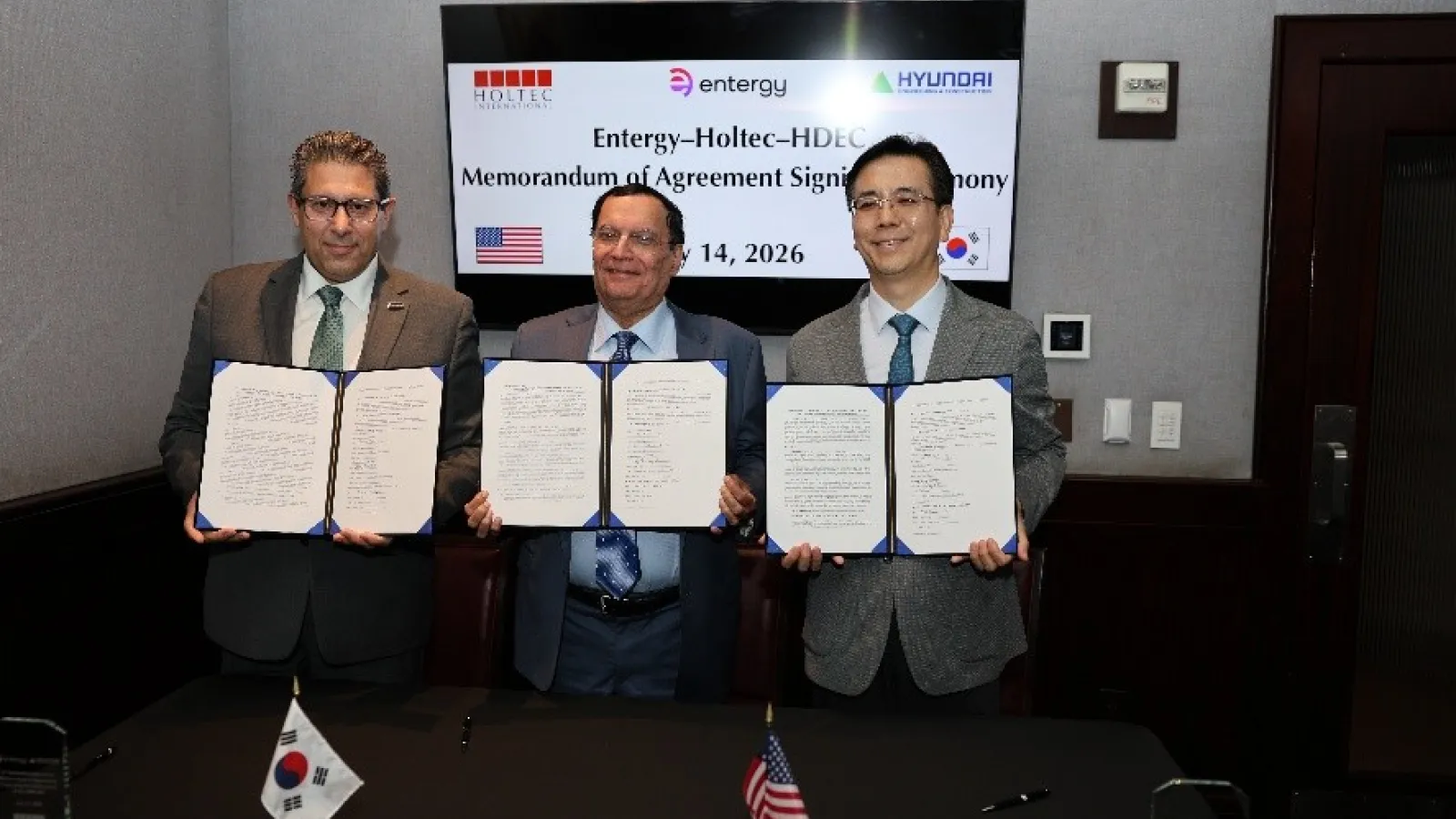
Holtec International, Entergy Services and Hyundai Engineering and Construction (HDEC) have signed a memorandum of agreement to jointly evaluate sites and commercial structures for dual-unit deployments of Holtec's SMR-300 small modular reactor across Entergy's four-state Gulf South service territory, covering Mississippi, Louisiana, Texas and Arkansas.
The deal is non-binding at this stage, but its industrial logic is pointed: the three parties are responding explicitly to surging electricity demand from AI-driven data centres and advanced manufacturing facilities. A dual-unit SMR-300 configuration would deliver roughly 680 megawatts of firm, carbon-free baseload capacity, and the collaboration frames that output as directly addressable to large-load customers who cannot be served reliably by intermittent renewables alone.
A vertically integrated nuclear delivery model
What makes this collaboration structurally significant is the integrated Engineering, Procurement and Construction model the parties are assembling. Holtec leads reactor technology, nuclear systems and domestic manufacturing; HDEC brings more than five decades of continuous nuclear plant construction experience and leads balance-of-plant delivery. A jointly managed project office is intended to provide unified oversight from component fabrication through commissioning.
The SMR-300 itself is a Generation III+ pressurised water reactor that uses standard nuclear fuel and fully passive safety systems. Its reference deployment at the Palisades site in Michigan, where Pioneer 1 and 2 units are under development, is designed to serve as the global template for subsequent fleet rollouts. Holtec says major components will be manufactured domestically at its Advanced Manufacturing Division, an important signal given ongoing policy pressure to onshore critical energy infrastructure supply chains.
Convergence angle: nuclear as the AI infrastructure play
The cross-sector significance of this MOA extends well beyond the energy industry. The Gulf South region hosts some of the United States' most energy-intensive industrial corridors, and the hyperscaler and colocation data centre buildout sweeping the US South is now colliding directly with grid capacity constraints. Traditional utilities in the region face a structural tension: renewable additions are variable, gas peakers carry carbon and price risk, and demand from AI compute clusters is both large and non-negotiable in its reliability requirements. Advanced nuclear, specifically the firm, dispatchable megawatt-hours that SMRs promise, is increasingly being positioned as the infrastructure layer beneath the AI economy, not merely an energy story.
Entergy's existing nuclear fleet, one of the largest in the US, gives the collaboration regulatory familiarity and grid integration experience that pure-play SMR developers lack. Pairing that with HDEC's construction track record addresses one of the sector's most persistent bottlenecks: the gap between reactor design approval and actual shovels in the ground. Korea's nuclear construction industry has repeatedly demonstrated the ability to deliver reactors on tighter schedules and budgets than Western counterparts, and bringing that capability into a US domestic deployment context is a deliberate hedge against the cost-overrun risk that has haunted large nuclear projects in the West for two decades.
From a capital-allocation perspective, the timing aligns with a broader re-rating of nuclear assets. Technology companies including Google, Microsoft and Amazon have signed or explored power purchase agreements with nuclear operators in the past eighteen months, validating the thesis that hyperscaler demand can anchor the economics of new nuclear builds. If the Palisades reference plant progresses on schedule, the Gulf South evaluation framework gives Entergy a credible optionality play without committing capital prematurely, a rational posture given the still-unsettled regulatory timeline for first-of-a-kind SMR licensing at the US Nuclear Regulatory Commission.
The second-order implications reach further still. A successful SMR-300 commercial deployment in the Gulf South would create a replicable template for utility-scale advanced nuclear across the MISO and SERC grid regions, potentially unlocking a wave of similar utility-developer-constructor tripartite agreements. It would also strengthen the case for domestic nuclear manufacturing as a strategic industry, influencing both federal procurement policy and the investment calculus of sovereign and institutional capital increasingly focused on energy security as a geopolitical asset.