
HII marks ROMULUS unmanned vessel milestone in 10-ship Navy contract
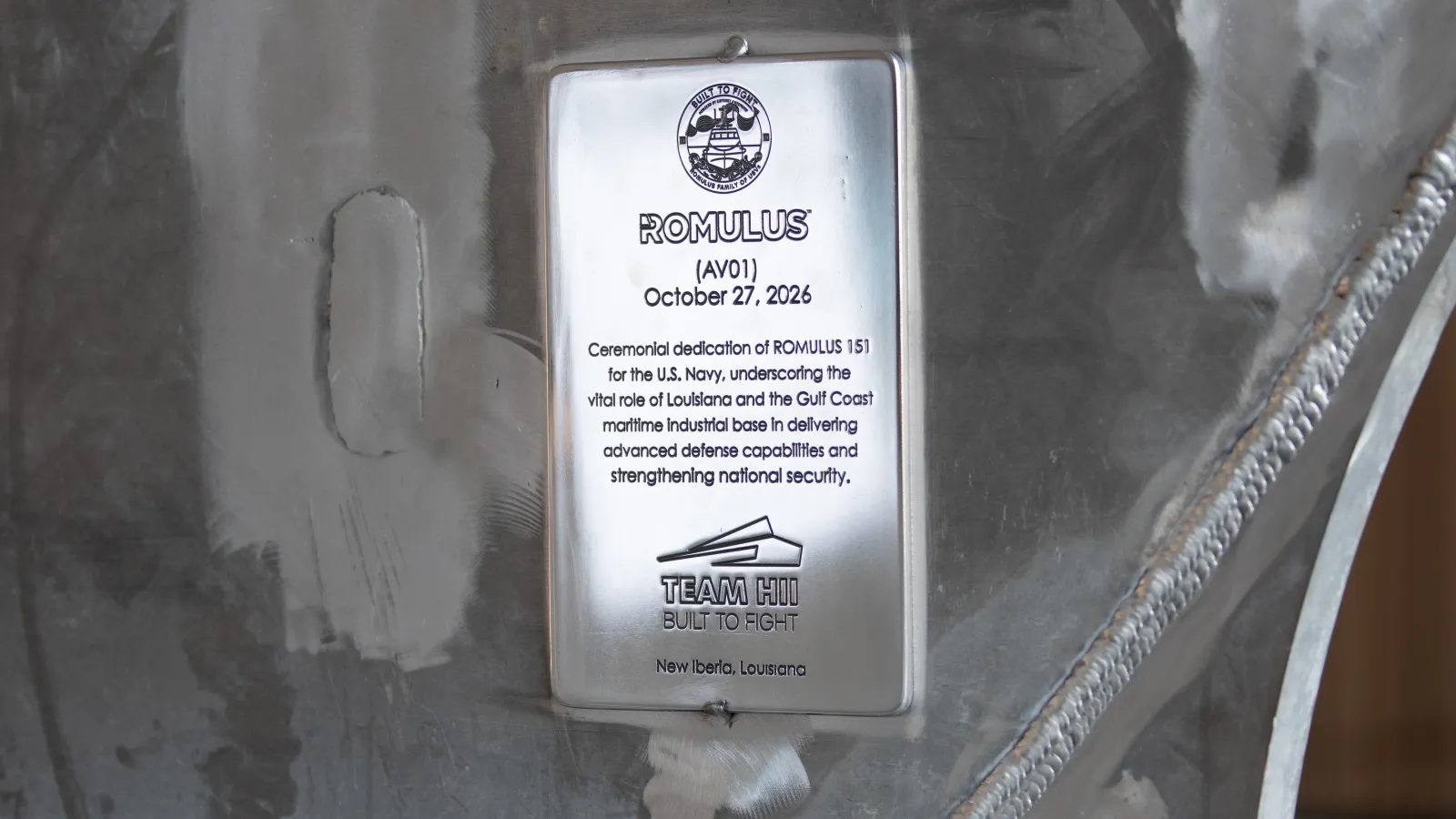
HII, the US Navy's primary shipbuilder, has marked a significant production milestone on its ROMULUS unmanned surface vessel (USV) programme, holding a ceremony in New Iberia, Louisiana to commemorate the ceremonial hull-plaque installation on the first-in-class ROMULUS 151 vessel. The event came on the back of a Navy contract to build ten of the medium-class autonomous vessels, signalling that the US military's investment in unmanned maritime systems is moving decisively from experimentation into operational fleet integration.
Louisiana Governor Jeff Landry attended alongside Vice Admiral Michael Wosje, deputy chief of naval operations for Warfighting Requirements and Capabilities, and HII President and CEO Chris Kastner, underlining the political and institutional weight behind the programme. The contract reinforces the Gulf Coast's position as a key node in the US defence industrial base, with production distributed across several Louisiana-based maritime partners including Breaux Brothers Enterprises, Halimar Shipyard and Bayou Metal Supply and Manufacturing.
From concept to fleet: autonomy at operational scale
At the technical heart of the ROMULUS platform is HII's Odyssey Autonomous Control Solutions (ACS), a modular, open-architecture autonomy suite developed alongside partners including Applied Intuition and Greenroom Robotics. During the Navy's evaluation phase, Odyssey completed a 420-nautical-mile, 28-hour long-endurance mission in the Gulf of America, meeting all Navy success criteria. The system enables vessels to navigate, manage payloads, coordinate with manned and unmanned platforms, and execute complex missions with limited human oversight.
The ROMULUS 151 is designed for a broad mission envelope: intelligence, surveillance and reconnaissance (ISR); mine countermeasures; strike operations; counter-unmanned systems; and the launch and recovery of both underwater and aerial drones. Its modular architecture allows the integration of emerging sensors and command-and-control technologies as requirements evolve, a design philosophy that reduces obsolescence risk for a Navy that is writing doctrine for autonomous warfare in real time.
Vice Adm. Wosje described the MUSV as "an essential tailored offset within the CNO's Hedge Strategy," citing its role in "expanding distributed lethality and maritime domain awareness across contested waters." The framing is notable: the Navy is openly positioning autonomous surface vessels not as support assets but as asymmetric force-multipliers in high-threat, contested environments.
Convergence signals: defence autonomy meets the industrial base
The ROMULUS programme sits at the intersection of several macro-level trends that matter beyond the defence sector. First, the decision to rely on a distributed Gulf Coast production network rather than a single large yard reflects a deliberate industrial-resilience strategy, a direct lesson drawn from supply-chain fragility exposed during and after the pandemic era. For cross-sector investors watching defence procurement, the programme demonstrates how distributed manufacturing models are migrating from commercial logistics into sovereign defence supply chains.
Second, the platform's open-architecture AI stack has implications for the robotics and autonomous-systems investment landscape more broadly. The autonomy software underpinning the ROMULUS, collision avoidance, multi-domain coordination, extended endurance without human intervention, is structurally similar to capabilities being developed for autonomous commercial shipping and port logistics. Capital allocators tracking the convergence of defence-grade autonomy with civilian maritime and logistics applications will find the Odyssey ACS architecture worth monitoring; technology matured under Navy contracts has historically migrated into commercial markets once reliability thresholds are established.
Third, the programme is a concrete data point in the broader debate about Western nations rebuilding sovereign defence-industrial capacity. The UK, Australia (under AUKUS) and several NATO members are weighing similar investments in unmanned maritime systems and domestic production capability. HII's distributed Louisiana model could serve as a reference architecture for allied programmes seeking to blend proven autonomy software with regional industrial workforces, rather than concentrating production in a single prime contractor's yard. As defence budgets in Europe and the Indo-Pacific continue to expand, the strategic logic of the ROMULUS model is likely to travel.