
IP Fabric links app layer to network twin in cloud-native overhaul
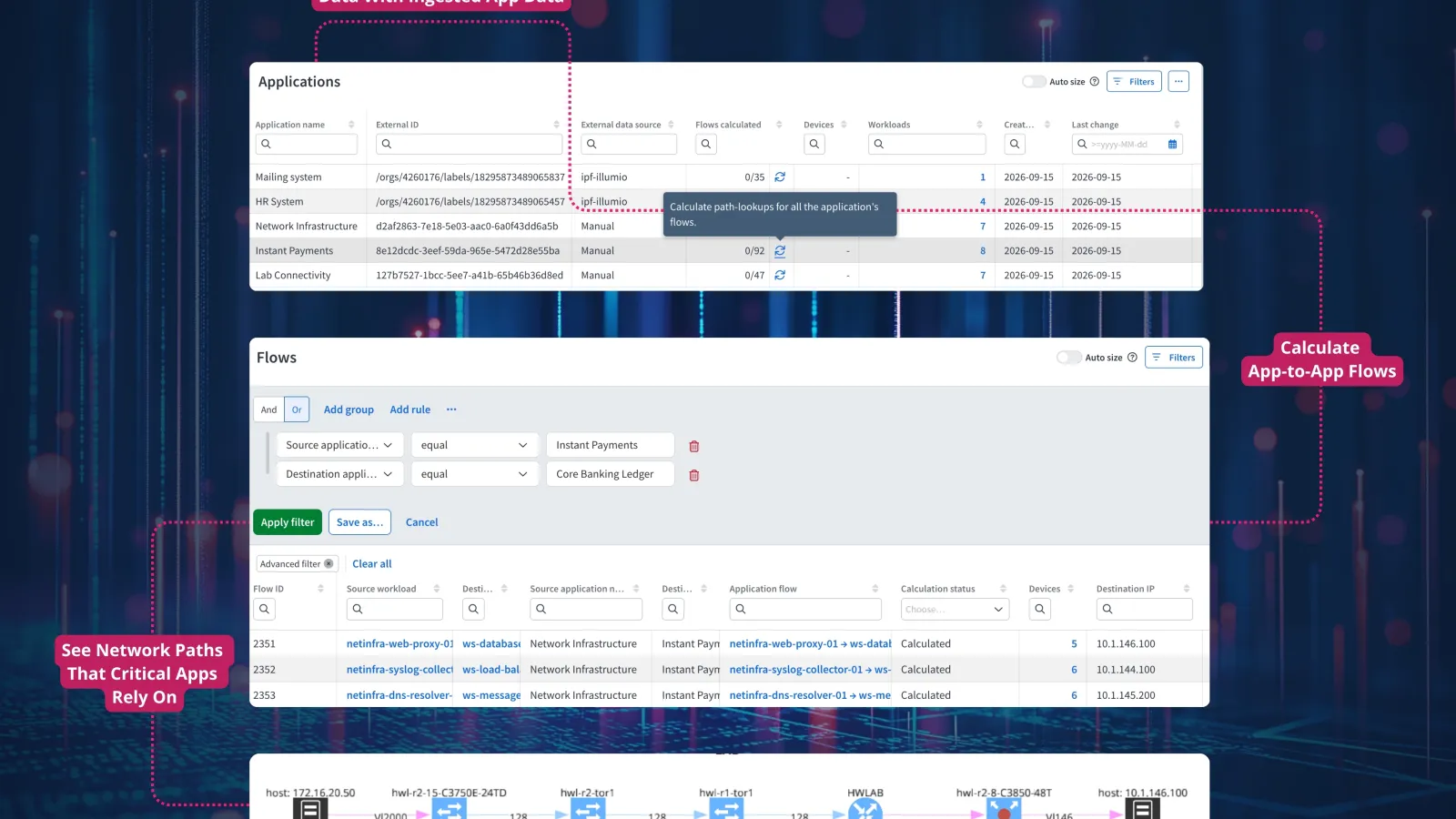
IP Fabric, the Boston-based network digital twin vendor, has shipped version 8.1 of its platform, adding application-aware infrastructure mapping and a redesigned cloud-native data model. The release positions the company at a convergence point that is rapidly becoming one of enterprise IT's most contested battlegrounds: the gap between where AI agents operate and the infrastructure data those agents actually need to be trusted.
The core problem IP Fabric is addressing is structural. As enterprises push AI and automation deeper into network operations, the quality of underlying data determines whether those systems can act reliably or merely guess. Application inventories, network paths, cloud resources and security policies typically sit across separate tools: APM platforms, configuration management databases, cloud consoles and microsegmentation systems. That fragmentation, the company argues, is what makes AI-assisted operations brittle.
Bridging the application and infrastructure divide
The new application infrastructure mapping capability introduces applications, workloads and flows as first-class objects within the platform. Crucially, this data is accessible through IP Fabric's hosted Model Context Protocol (MCP) server, meaning AI agents can query evidence-grade network, cloud and application context in natural language rather than parsing fragmented inventories. The first native integration delivering application and workload context comes via a partnership with Illumio, the microsegmentation specialist, with further integrations planned via API or CSV ingestion.
The redesigned cloud-native data model treats VPCs, VNets, subnets, route tables, peerings and security policies as native entities, improving path analysis across hybrid multi-cloud environments. The platform can now evaluate AWS Security Groups, network access control lists and Azure Network Security Groups to determine whether traffic is permitted or blocked, surfacing the specific policy responsible. A new Cloud Consumption Units licensing model aims to make coverage planning more predictable as deployments expand.
CEO Pavel Bykov framed the strategic intent plainly: "Enterprises want AI and automation to take on more operational work, but neither can be trusted when the underlying data is incomplete or inferred. IP Fabric is the ground truth that organisations need to understand what critical applications depend on, what is at risk when the environment changes and whether the intended outcome was achieved."
The governance architecture behind the data layer
IP Fabric's deliberately read-only architecture is worth examining as a design choice, not just a product feature. By separating the system that analyses infrastructure state from the systems that execute changes, it creates an audit-friendly governance layer for AIOps: AI recommends, another system acts, and IP Fabric independently validates the outcome. That separation of duties is increasingly relevant as regulators in the EU and UK begin scrutinising how enterprises govern automated decision-making in critical infrastructure.
The convergence angle here extends well beyond enterprise IT operations. Hybrid multi-cloud environments are now the substrate for everything from financial-services transaction processing to pharmaceutical manufacturing execution systems. When an AI agent misreads network topology and recommends a change that degrades application performance, the downstream cost is not merely an IT incident. For a trading platform or a clinical data pipeline, it can be a compliance failure. The demand for a verified, vendor-neutral "ground truth" layer that AI agents can query without executing changes represents a distinct infrastructure category: not AIOps tooling per se, but the data-assurance foundation beneath it.
That category is attracting attention across the capital landscape. Infrastructure observability and network assurance have drawn sustained venture investment, with peers such as Kentik, Forward Networks and Apstra (now part of Juniper) all staking positions in automated network intelligence. IP Fabric's move to connect the application layer explicitly, and to expose that data through an MCP server that AI agents can query natively, sharpens its differentiation in a field where the competitive moat increasingly lies in data fidelity rather than feature breadth.
For cross-sector leaders, the signal is clear: the next wave of AIOps credibility will be won or lost at the data layer. Vendors who can provide verified, deterministic infrastructure context, rather than inferred or aggregated approximations, will become the quiet load-bearing pillars of the agentic enterprise. IP Fabric's v8.1 is a deliberate bid for that position.