
StraitsX and ADATA target stablecoin settlement for chip trade
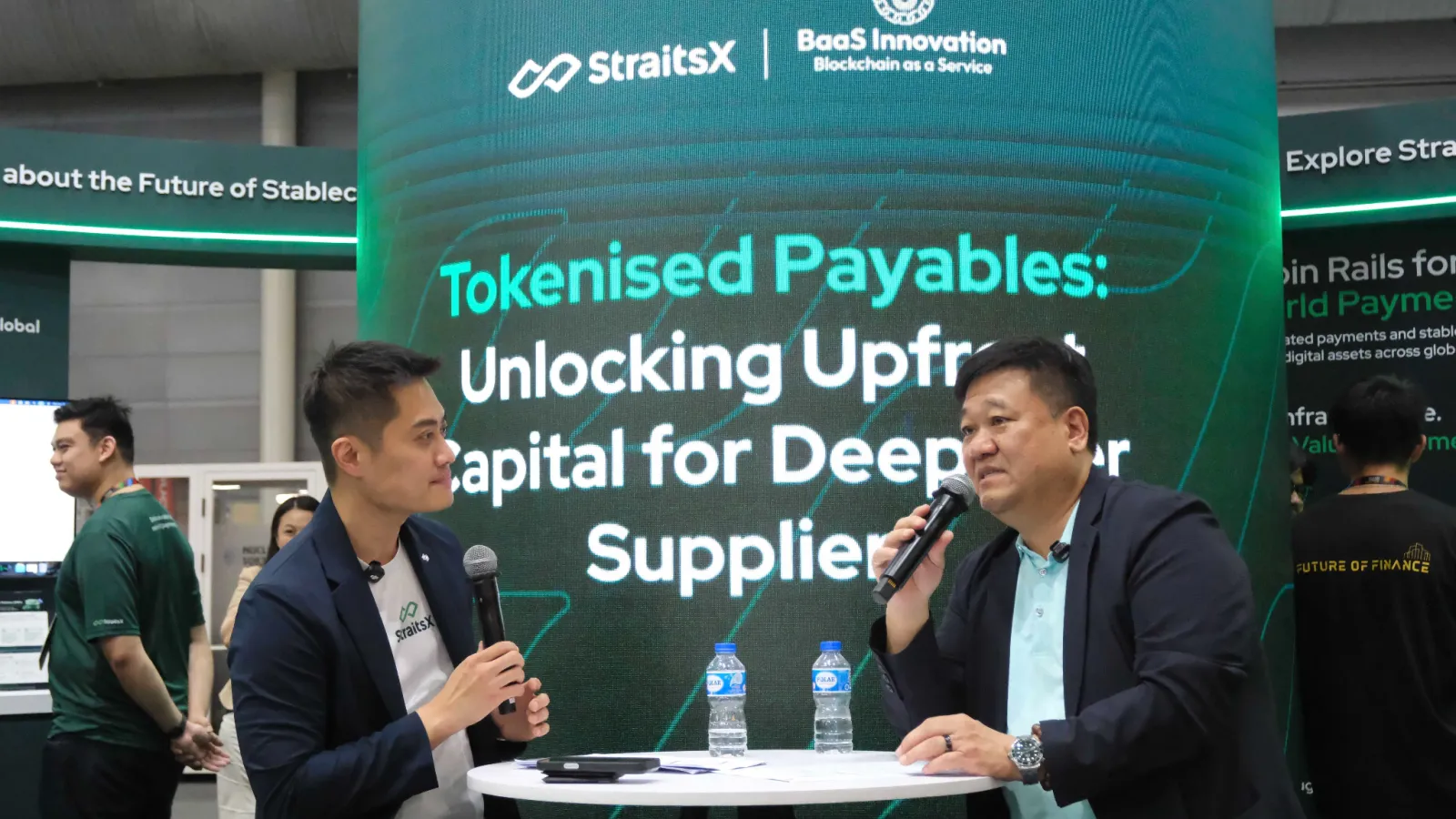
StraitsX, the Singapore-licensed stablecoin issuer, has signed a Memorandum of Understanding with ADATA Technology, Taiwan's second-largest DRAM and SSD manufacturer, and BaaS Innovation, ADATA's blockchain-services subsidiary, to explore whether stablecoin-powered settlement can replace conventional cross-border payment cycles in semiconductor hardware trade. The MOU identifies StraitsX's Singapore-dollar and US-dollar stablecoins, XSGD and XUSD, as candidate instruments, with an ambition to compress settlement from the industry-standard T+2 to near-instant T+0.
The release positions the collaboration as an early-stage exploration rather than a live deployment. All implementation is subject to technical, commercial, and regulatory assessment across multiple jurisdictions, and no pilot timeline is specified. That caution is consistent with the Monetary Authority of Singapore's evolving single-currency stablecoin framework, under which StraitsX holds a Major Payment Institution licence and says it is substantively compliant with forthcoming rules.
Stablecoins meet supply chain finance
Beyond raw settlement speed, the MOU sketches a more structurally significant use case: the tokenisation of ADATA payables. Under the concept, eligible supplier invoices would be represented as digital tokens, potentially allowing upstream component makers to access financing before payment maturity, rather than waiting for standard invoice terms to expire. Combined with smart-contract-enabled flows and Purpose Bound Money frameworks, a programmable-money concept pioneered by MAS, the architecture could allow automated settlement on invoice maturity or early payment via third-party liquidity providers.
"Real-world commercial utility is the next major frontier for stablecoins," said Tianwei Liu, CEO and co-founder of StraitsX. "Through this collaboration with ADATA and BaaS Innovation, we are exploring how stablecoins such as XSGD and XUSD, together with tokenised payables, could help modernise cross-border settlement and unlock greater efficiency across global semiconductor supply chains."
The liquidity angle matters for ADATA's supplier base. Memory and storage component supply chains are capital-intensive, with upstream suppliers, fab subcontractors, packaging houses, raw-materials providers, typically carrying long receivables cycles. If tokenised payables can be discounted against third-party liquidity pools on-chain, it would reduce working-capital pressure without requiring suppliers to renegotiate bilateral credit terms with a large OEM buyer.
A convergence bet on semiconductor trade finance
The strategic read-across for Disrupts readers sits at the intersection of three converging pressures. First, semiconductor supply chains have become a geopolitical asset class: Western governments and their allies are actively subsidising domestic chip capacity, which raises the volume and complexity of cross-border hardware flows that need efficient settlement rails. Second, the stablecoin regulatory environment is crystallising in Singapore, the EU (under MiCA), and increasingly in the US, giving institutional counterparties the compliance anchor they need to trial blockchain settlement in real trade flows. Third, tokenised trade finance is attracting serious capital: the likes of JPMorgan's Onyx, HSBC's Orion platform, and a growing cohort of APAC-focused fintechs are all competing to place their infrastructure at the centre of supply chain settlement, a market that the Asian Development Bank estimates carries trillions of dollars in annual trade finance gaps globally.
ADATA's participation as an anchor trade partner is notable precisely because it brings genuine, high-volume transaction flows rather than synthetic test cases. As the world's second-largest branded DRAM module maker with operations across Taiwan, China, the US, Brazil, and Mexico, its invoicing volumes span exactly the multi-jurisdiction complexity that stablecoin settlement is designed to address. Whether the MOU converts to a live pilot will depend on how quickly the relevant regulatory regimes align, but the structural logic, faster, programmable settlement for a supply chain that is now a matter of national industrial policy in multiple economies, is coherent and timely.