
Geely and Ford form Valencia JV to build EVs for Europe
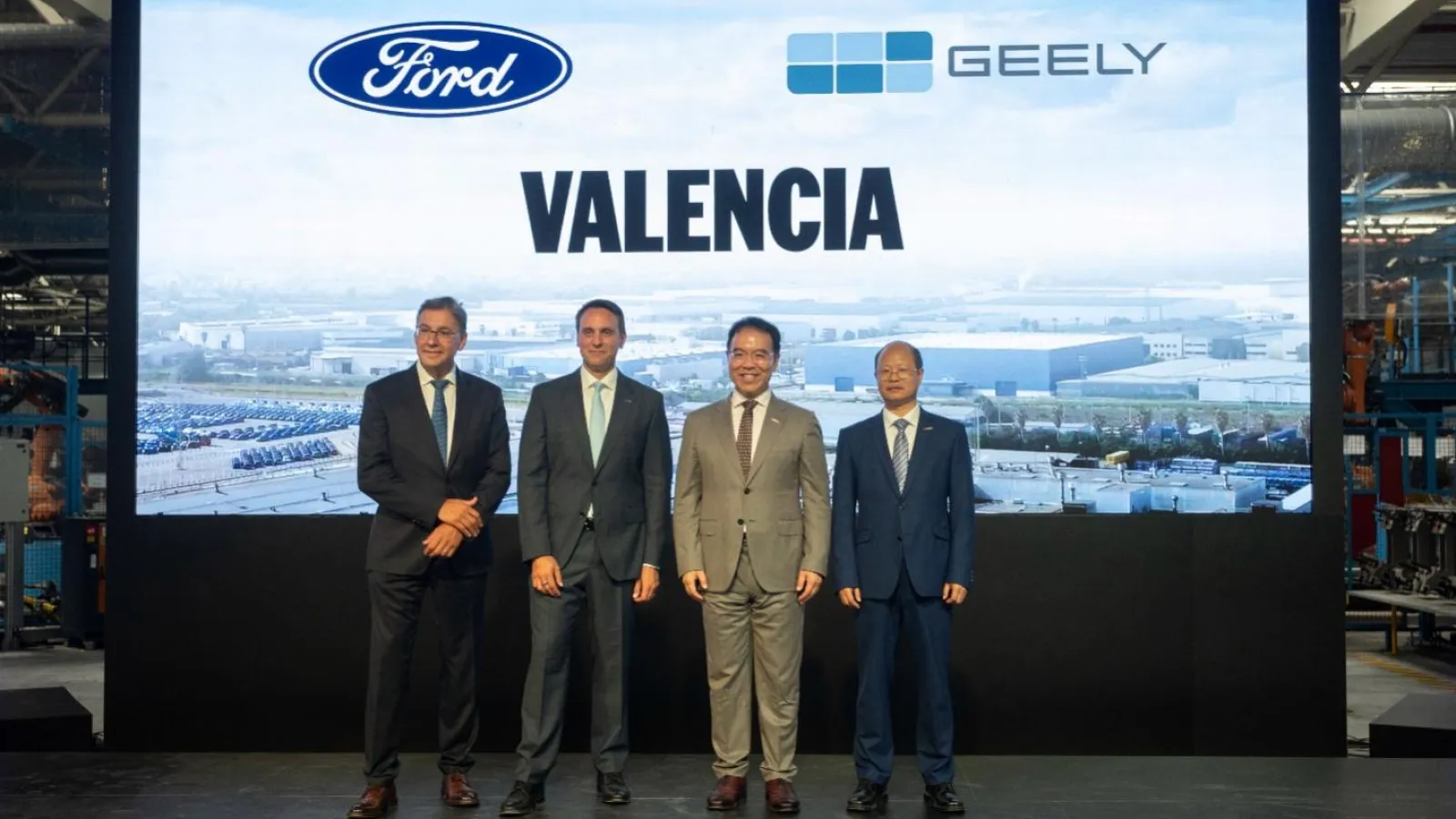
Geely Auto and Ford Motor Company have agreed to establish a Europe-focused manufacturing joint venture at Ford's Valencia facility in Spain, creating a shared production hub for five vehicle lines across both brands. Pending regulatory clearance, the entity will begin operations in the first half of 2027, with the first vehicles rolling off the line in 2028. Ford retains a 66% controlling stake; Geely Auto holds 34%.
The deal plants a Chinese automaker inside one of Western Europe's most productive automotive plants, with annual capacity of approximately 500,000 units. The JV will manufacture three Ford-branded multi-energy vehicles alongside two electric Geely-branded models, all targeted at European markets. The arrangement is explicitly structured to share development costs and optimise factory utilisation, addressing the cost-benchmark pressure that is squeezing European OEMs as Chinese-built EVs continue to undercut on price.
A Chinese foothold in European manufacturing
Geely's rationale is clear in the numbers. The company reported overseas sales of 474,228 vehicles in the first half of 2026, a year-on-year increase of 158%, making it among the fastest-growing Chinese automotive brands globally. Yet export-led growth increasingly collides with the European Union's provisional tariffs on Chinese-made EVs, which have reshaped the economics of selling into the bloc from Chinese factories. By co-producing inside Spain, Geely sidesteps that tariff wall and gains a "Made in Europe" credential that carries regulatory and reputational weight with EU consumers and policymakers alike.
Jim Baumbick, president of Ford Europe, framed the partnership in competitive terms: "Together we can fully utilise a great plant with a great workforce and match the industry's new cost benchmark." That phrase, "new cost benchmark," is a pointed acknowledgement that legacy European OEMs are being forced to restructure their cost bases to compete with Chinese rivals. Ford is, in effect, inviting one of those rivals into its own facility to achieve the efficiency it cannot reach alone.
Convergence of capital, regulation and supply chain
The Valencia agreement sits at a broader convergence point between geopolitics, trade policy and automotive capital allocation. European automakers are caught between two competing pressures: the EU's 2035 combustion-engine phase-out mandate, which demands accelerated EV investment, and a trade environment that makes pure Chinese-import strategies untenable post-tariff. Joint ventures of this kind represent a third path: Chinese capital and EV platform expertise pooled with Western brand equity, distribution networks, and local manufacturing footprints.
For investors tracking cross-border automotive M&A, the structure is instructive. Rather than a full acquisition, both parties retain brand independence while sharing fixed costs across a single plant floor. This capital-light convergence model, where Chinese OEMs provide electrification technology and Western partners provide market access and manufacturing infrastructure, is likely to be replicated. Stellantis has explored similar arrangements; Volkswagen's partnership with SAIC in China has long operated on analogous logic, now running in reverse.
The sustainability dimension should not be understated. The Valencia plant's output will be exclusively low- and zero-emission vehicles, aligning with Spain's industrial decarbonisation commitments and EU Green Deal targets. For sovereign and institutional investors with ESG mandates, a Spanish-domiciled, EU-regulated EV manufacturing entity with Chinese technological input and American brand heritage represents a genuinely novel asset profile.
The road ahead
The JV still requires regulatory approval, and EU scrutiny of Chinese automotive investments has sharpened considerably in 2026. The degree to which Geely's battery and powertrain supply chain remains China-sourced will be a key question for both regulators and investors assessing the venture's true localisation credentials. If the Valencia model proves commercially viable, it may well become the template through which Chinese EV platforms enter Europe in the next cycle, not as imports, but as co-productions.