
Firefly Aerospace clears design review for NASA lunar drone mission
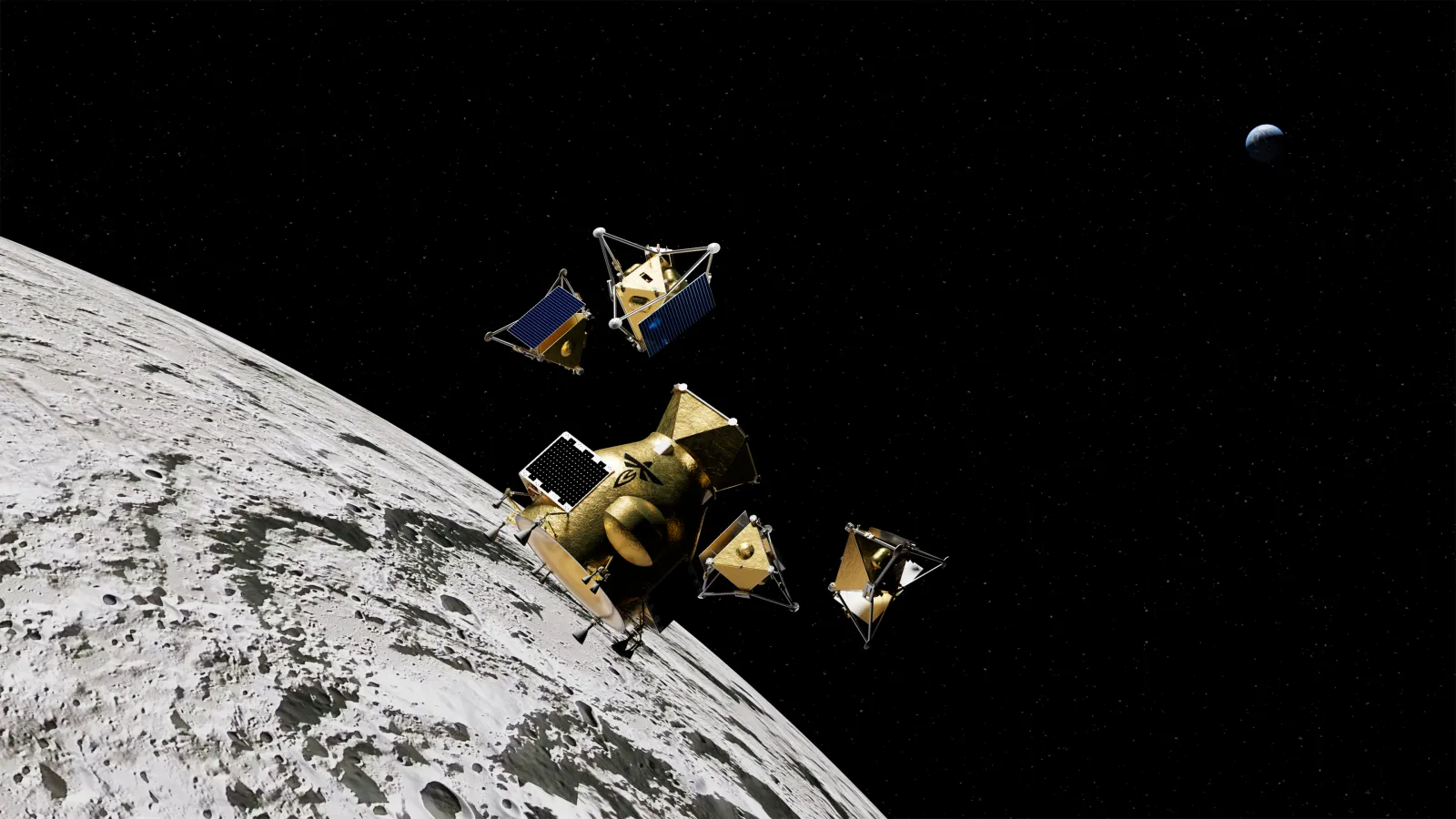
Firefly Aerospace has completed the preliminary design review (PDR) for its Elytra spacecraft, which will carry drones built by NASA's Jet Propulsion Laboratory (JPL) to the Moon's south pole as part of the agency's MoonFall mission. The milestone, reached less than four months after contract award, clears Firefly to proceed toward a critical design review ahead of hardware production. A launch readiness date of late 2028 is targeted.
The PDR covered the full technical stack of the Elytra vehicle, including structural integrity, thermal management, propulsion, avionics, trajectory design, guidance and navigation, and communications systems. Once launched, Elytra will transit from Earth orbit to lunar orbit and deploy JPL's drones above the Moon's south pole. Those drones, equipped with high-definition optical cameras and survey instruments, will map terrain, identify safe landing zones, and catalogue resources to support future crewed missions. NASA will separately source the launch vehicle.
From milestone to infrastructure
MoonFall sits within the first phase of NASA's Moon Base Programme, a long-term initiative designed to underpin sustained human presence at the lunar south pole. The programme's ambitions extend well beyond scientific survey: commercial resource extraction, in-situ infrastructure build-out, and eventually permanent habitation are all framed as downstream objectives. Firefly's role as spacecraft integrator and transit vehicle supplier places it at a critical chokepoint in that supply chain.
Ray Allensworth, Firefly's Vice President of Spacecraft, said the PDR achievement reflects "the speed and rigor Firefly brings to every mission," adding that the company is "rapidly scaling spacecraft production" off the back of its Blue Ghost lunar lander mission, which marked Firefly as the first commercial operator to achieve a successful Moon landing.
The convergence angle: lunar logistics as a capital magnet
The broader significance of milestones like this one extends beyond any single contract. The lunar south pole has become the focal point of a new category of infrastructure investment, where defence procurement logic, sovereign space programmes, and commercial resource-extraction ambitions are converging in a way that did not exist five years ago. The south pole's suspected water-ice deposits are not merely a scientific curiosity; they represent a potential feedstock for in-space propellant production, which would fundamentally alter the economics of deep-space logistics.
For cross-sector investors, Firefly's publicly listed status on Nasdaq (ticker: FLY) makes it one of the few pure-play commercial lunar infrastructure names accessible via public markets, at a time when most comparable activity remains locked inside defence primes or private ventures. The company's vertical integration model, with engineering, manufacturing, and test facilities co-located in central Texas, is structured to compress the cost and timeline of iterative spacecraft production, a model that mirrors the lean-manufacturing logic reshaping adjacent sectors from automotive to satellite manufacturing.
The capital landscape around lunar infrastructure is broadening. Sovereign space agencies from the US, Japan, and the UAE are all committing resources to south-pole-adjacent programmes, and commercial players are beginning to layer in alongside them. The question for investors is whether the current cluster of design reviews and contract awards translates into a durable, recurring procurement cycle or remains concentrated in a handful of high-profile NASA-backed missions. Firefly's growing manifest of lunar surface contracts suggests the company is positioning for the former. The CDR, expected in the months ahead, will be the next signal to watch.