
Agentic AI onboarding: providers ready, consumers are not
Signicat, the European digital identity and fraud prevention platform, has published research revealing a sharp trust gap at the heart of agentic AI adoption in financial services. While 79% of financial services providers say they are prepared to accept applications initiated by AI agents, just 14% of consumers are comfortable letting an AI open a financial product on their behalf. The findings land at a pivotal moment, as Europe's financial sector positions itself for a wave of autonomous, agent-driven customer interactions.
The report, The Battle to Onboard 2026: The AI Reality Check, surveyed 4,050 consumers and 450 business decision-makers across nine European markets, including the UK, Germany, France and the Nordic countries. Its central finding is not simply that consumers are cautious: it is that years of digital investment have failed to close the trust deficit. Abandonment rates for online financial applications remain stubbornly high at 60%, only modestly improved from 68% in 2022, with consumers citing the same friction points: excessive data requests and lengthy processes.
Copilot, not autopilot
The data reveals a nuanced consumer position. The majority of respondents (65%) are open to AI assistance with financial applications, provided they retain decision-making authority. Only 11% want AI to complete an application entirely on their behalf. Trust collapses further when higher-stakes actions are involved: just 15% would allow an AI to use their digital identity for bank verification, and 14% would permit AI to sign contracts to open an account. By contrast, 42% are comfortable letting AI suggest recipes and 38% are happy for it to draft emails.
"The gap between provider expectations and consumer comfort with AI is an issue that financial services have faced many times before, from online banking to contactless payments," said Emma Bauer, CPO at Signicat. "How quickly it happens, and which providers are best positioned to benefit, will hinge on building trust and ensuring that people, businesses and AI agents can interact securely and with confidence. That means preparing now, with measures such as real-time fraud prevention and Know Your Agent frameworks."
One counter-intuitive finding cuts against the assumption that digital maturity accelerates AI appetite. Norway, Europe's leader in digital ID adoption, recorded the highest resistance to agentic financial onboarding: 79% of Norwegian consumers were uncomfortable with AI opening a product on their behalf. Finland (78%) and Sweden (73%) followed closely. The UK sits at 69% uncomfortable. Digitally sophisticated markets, it appears, are more alert to the risks of delegation, not less.
The convergence stakes
The Signicat findings carry implications well beyond identity verification. The agentic AI era assumes that software agents will increasingly act as economic participants: negotiating, contracting, transacting. Financial services is the most regulated and highest-stakes arena in which that assumption is now being tested. The readiness gap identified here is effectively a proxy for the pace at which the broader agentic economy can scale.
For the institutions investing in AI infrastructure, including the cloud platforms, model providers and orchestration-layer vendors that underpin agentic systems, the consumer trust lag represents a genuine commercial constraint. Deployment budgets are running ahead of adoption curves. The regulatory dimension compounds this: frameworks such as eIDAS 2.0 and the proposed Know Your Agent standards are still being defined, meaning that providers building agentic onboarding pipelines are doing so against an unsettled compliance backdrop.
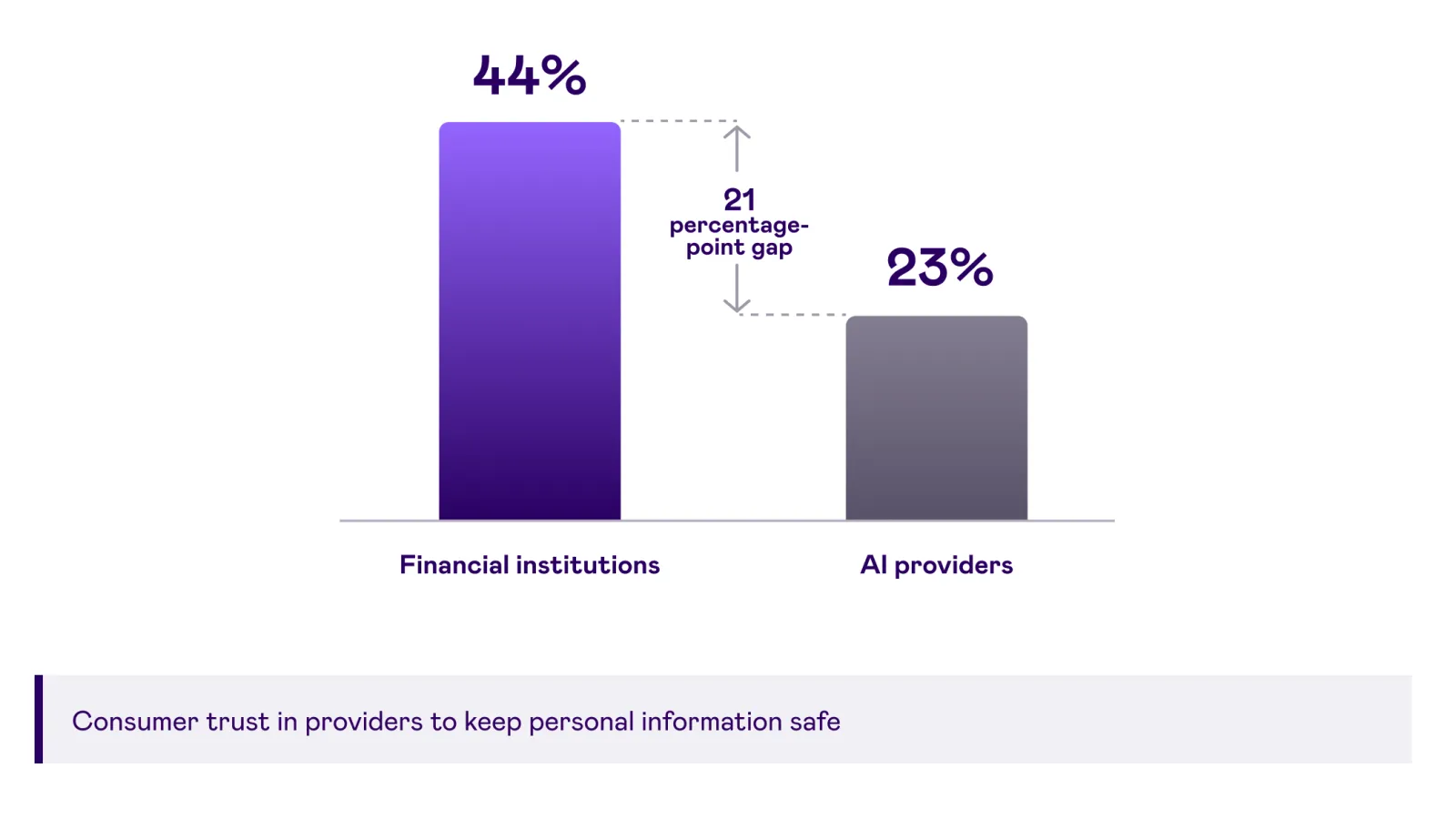
One structural advantage for incumbents stands out from the data. Consumers are nearly twice as likely to trust established financial providers (44%) with their personal data as they are to trust AI providers (23%). That asymmetry gives regulated banks and insurers a material head-start in deploying agent-mediated services, provided they can convert institutional trust into product design that respects the consumer's evident preference for remaining in the loop. The race is less about who can deploy agentic AI fastest, and more about who can do so without triggering the abandonment behaviour the industry has spent four years failing to fix.