
Teen's low-cost eDNA sampler wins top prize at Thermo Fisher JIC
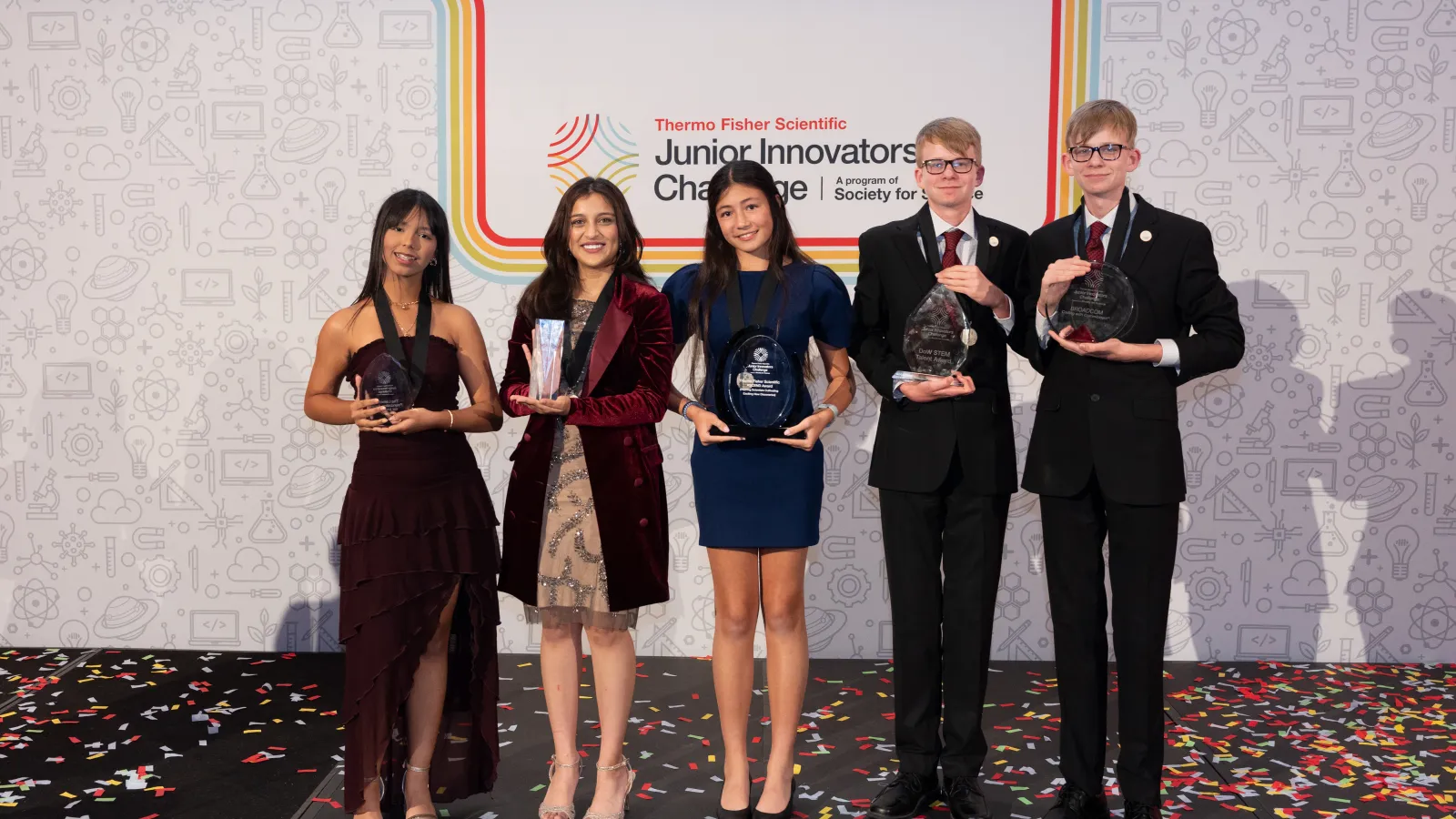
A 15-year-old from Fort Lauderdale has won the top prize at one of the United States' leading middle-school science competitions with a device that could bring environmental pathogen surveillance to communities that currently cannot afford it. Bailey Quinn Frank's low-cost environmental DNA (eDNA) sampler, constructed from a small fan and filter paper, drew the $25,000 ASCEND Award at the 2026 Thermo Fisher Scientific Junior Innovators Challenge (JIC), run in partnership with the Society for Science.
The core idea is straightforward but consequential: existing airborne-bacteria monitoring relies on laboratory-grade equipment that is prohibitively expensive for rural health districts. Frank's sampler captures airborne particulates on filter paper, which can then be tested for pathogen DNA. The device sidesteps the cost barrier almost entirely. That framing sits squarely in a wider debate about how diagnostic and environmental-monitoring infrastructure gets distributed globally, a question that has taken on fresh urgency since Covid-19 exposed the surveillance gaps between well-funded urban health systems and rural or low-income regions.
Convergence at the bench
The JIC finalists' projects are a useful snapshot of where the next generation of researchers perceives the most tractable problems. Several winning entries crossed disciplinary boundaries in ways that mirror the convergence thesis driving investment in deep tech more broadly. Myreen Ahsan, 14, used machine-learning screening to identify candidate molecules targeting tau protein misfolding in frontotemporal dementia, a method structurally similar to the computational drug-discovery pipelines now attracting nine-figure venture rounds from groups such as Recursion and Isomorphic Labs. That a 14-year-old is applying the same logic independently is less a curiosity than a signal: the tooling has become accessible enough to reach secondary-school science fairs.
Twin brothers Henry and Jack Grover, both 14, tackled fire-reignition risk using sodium polyacrylate hydrogels, motivated by the 2025 Palisades fire. Their project touches a genuinely cross-sector problem space: wildfire mitigation sits at the intersection of materials science, insurance-loss modelling, and municipal infrastructure planning. Wileidy Enid Feliciano-Rivera, 13, from Puerto Rico, developed a biodegradable mulch from plantain peels that matched conventional plastic mulch for weed suppression while improving soil moisture retention, a low-input circular-materials approach with implications for both agricultural productivity and plastics-reduction mandates.
Capital, access, and the pipeline question
The broader significance of the JIC for Disrupts readers lies not in the individual projects but in what the competition says about the STEM talent pipeline and the institutions funding it. Thermo Fisher Scientific's sponsorship reflects a corporate-balance-sheet commitment to upstream talent development that sits alongside its core $45bn-revenue scientific-instruments business. Other prize sponsors include Broadcom, Citadel and Citadel Securities, and the Lemelson Foundation, a cross-sector coalition that spans semiconductor infrastructure, quantitative finance, and invention philanthropy. The presence of Citadel and Broadcom alongside a life-sciences giant is not incidental: all three depend on the same downstream supply of quantitatively literate graduates.
The talent-pipeline concern is particularly acute as AI-augmented research compresses the time between hypothesis and experimental validation. If machine-learning tools lower the barrier to drug-target identification or materials screening to the point where a motivated 14-year-old can run credible experiments, the competitive advantage shifts toward the institutions, regions, and countries that invest earliest in scientific literacy. Frank's eDNA device illustrates the other side of that equation: the ability to design useful, deployable diagnostics with minimal capital input is itself a form of technological sovereignty, enabling communities to monitor their own environmental health rather than depending on centralised laboratory infrastructure.
The 30 JIC finalists were selected from nearly 2,000 applicants across 47 states and five territories. Collectively they received more than $100,000 in awards. Each finalist's school also received a $1,000 STEM programming grant.