
ControlUp: sign-in faults drive half of all enterprise help desk load
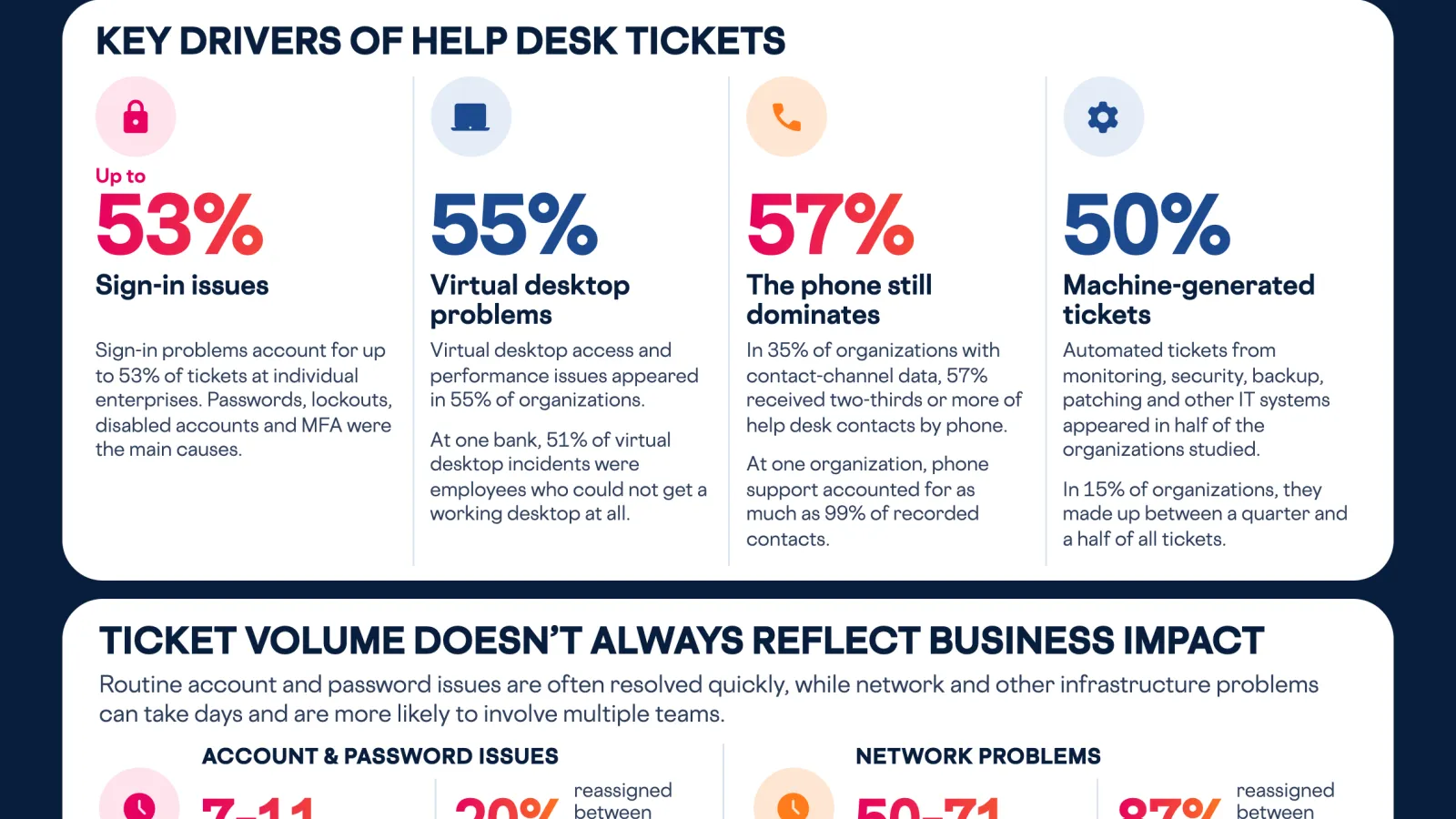
ControlUp, a San Francisco-based IT operations platform, has published findings from a study of more than 1.06 million enterprise help desk tickets, revealing that sign-in failures, password resets, account lockouts, disabled accounts, and multi-factor authentication (MFA) enrolment errors, account for as much as 53% of all tickets at individual organisations analysed. The research spans retail, healthcare, financial services, manufacturing, construction, energy, and IT services enterprises, and its implications reach well beyond IT departments.
The headline figure, striking as it is, masks a more strategically significant finding: volume and impact are poorly correlated. Routine account and password tickets were typically resolved in under 11 minutes at one large enterprise surveyed, while network outages at the same organisation carried a median resolution time of 50 hours. At one retailer, tickets for whole-site network failures took a median of nearly a week to close. The lesson is that IT teams optimising for ticket closure speed may be systematically under-investing in the problems that actually hurt business continuity.
Authentication as a systemic risk vector
MFA issues registered as a named ticket driver in 40% of the organisations studied, with one in five organisations directly linking elevated volumes to employees switching or upgrading smartphones. At one construction firm, MFA resets following phone upgrades became the single largest ticket category at 7.5% of all support demand. This is not a helpdesk curiosity; it is an enterprise security architecture problem surfacing as an operational cost.
Virtual desktop infrastructure added further complexity: access and performance issues appeared in 55% of the organisations analysed. At one bank, 51% of all virtual desktop incidents involved employees who could not obtain a working session at all, with roughly half of those tickets reassigned between teams before resolution. Machine-generated tickets from monitoring, security, patching, and backup systems appeared in half of the organisations studied, and in 15% of cases accounted for between a quarter and a half of total ticket volume, a reminder that automation is simultaneously a cost driver and a potential remedy.
"IT organisations have traditionally measured support performance by how quickly they close tickets, but that doesn't tell the whole story," said Simon Townsend, Senior Vice President of Marketing and Office of the CTO at ControlUp. "A password reset that takes a few minutes and an infrastructure failure that disrupts an entire location shouldn't carry the same operational weight."
Convergence angle: agentic IT operations and the enterprise productivity stack
The ControlUp findings arrive at a moment when enterprise software buyers across sectors are being pitched on agentic AI platforms that promise to shift IT from reactive to predictive. The company's own Autonomous Endpoint Management (AEM) layer, which combines real-time endpoint telemetry with AI-driven remediation workflows, is positioned squarely in that market. The competitive landscape includes ServiceNow, Nexthink, and 1E, all of which are racing to embed large-model reasoning into IT service management.
For cross-sector investors, the data points to a structural inefficiency that scales badly. As enterprises in financial services, healthcare, and manufacturing deploy more digital-worker tooling, virtual desktops, zero-trust authentication stacks, edge endpoints, the support overhead compounds. Authentication failures that consume 53% of helpdesk capacity at a mid-size enterprise become an existential productivity drag at a bank or hospital network operating hundreds of thousands of endpoints. That dynamic makes IT operations automation a capital allocation story as much as a technology one, and it explains why enterprise-software-focused growth equity has remained active in the AEM and DEX (digital employee experience) category even as broader SaaS multiples have compressed.
The macro read-across is straightforward: the workforce productivity agenda that governments and CFOs are invoking to justify AI infrastructure spend will stall if the authentication and endpoint plumbing underneath it cannot keep pace. ControlUp's million-ticket dataset is a useful public benchmark, but the more consequential question is whether agentic remediation platforms can demonstrate measurable reduction in that 53% figure at scale, and whether enterprise buyers will fund proactive tooling before, rather than after, a major operational incident forces the decision.