
Robinson Unmanned R44 AIRTRUCK trials offshore cargo ops in Louisiana
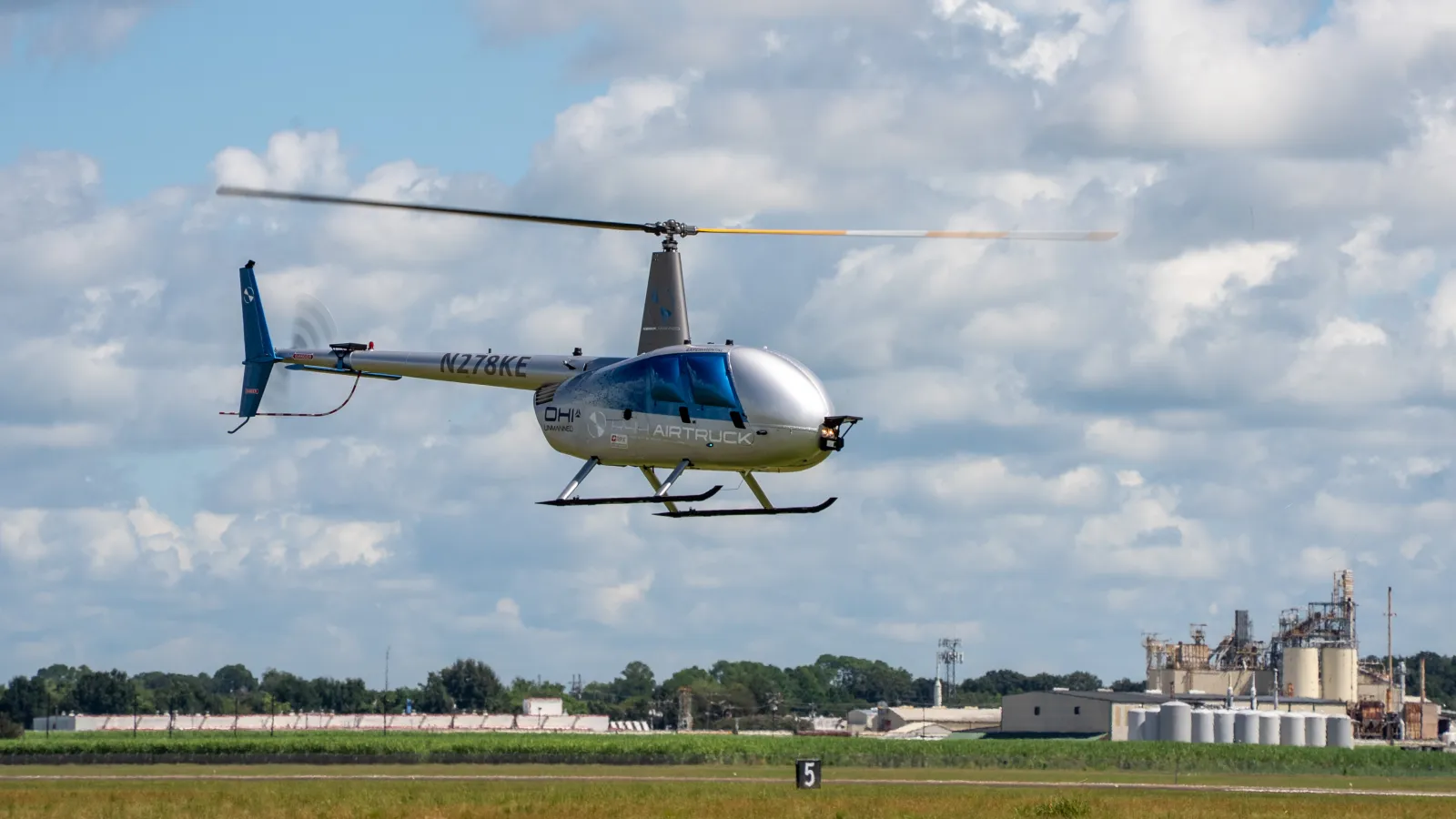
Robinson Helicopter Company's unmanned division has completed demonstration flights of its R44 AIRTRUCK remotely piloted cargo helicopter at Acadiana Regional Airport in New Iberia, Louisiana, positioning the aircraft squarely inside one of the most operationally demanding logistics corridors in North America. The two-day exercise, conducted on 2 and 3 September, was run by Aviation Academy of Louisiana in the presence of PHI Aviation alongside industry, government, and regulatory observers.
The choice of venue was deliberate. New Iberia sits at the heart of the Gulf of Mexico offshore supply chain, a network that has shuttled crews and cargo to deep-water and shallow platforms since 1947. The AIRTRUCK flew repeated approaches to a platform deck configured to replicate offshore conditions, demonstrating cargo loading and unloading, precision deck positioning, and airspace integration. It operated with a crew of just two: one remote pilot in command and one ground support technician, a footprint that matters considerably when operators calculate the cost-per-mission of keeping a platform stocked.
The airframe logic
The AIRTRUCK is built on the Robinson R44, the most widely produced helicopter platform in the world, converted for unmanned operation via Rotor Technologies' RPX flight system. It carries up to 1,000 pounds of useful load and more than 60 cubic feet of internal volume, cruises above 100 knots, and is rated to 14,000 feet. By retaining the certified R44 airframe, Robinson argues that operators inherit an existing parts and maintenance ecosystem rather than adopting an entirely novel and unproven supply chain.
"Offshore operators have spent decades moving crews and cargo to platforms in some of the toughest flying conditions there are," said David Smith, president and CEO of Robinson Helicopter Company. "When you build an unmanned aircraft on a proven helicopter, they don't trade away reliability to gain autonomy."
The company frames this as its "Era of Both" strategy: a shared-infrastructure model where the same technicians, parts, and procedures support manned and unmanned variants interchangeably. Aviation Academy of Louisiana, an authorised Robinson dealer and repair station, runs both fleets from the same facility, providing a live proof-of-concept for that support model in a field environment rather than a controlled test range.
Convergence: energy logistics meets autonomous aviation
The offshore energy sector presents one of the clearest near-term commercial use cases for heavy-lift uncrewed aircraft, and that makes this demonstration notable beyond its aviation-sector context. Offshore platforms depend on a constant logistics rhythm for consumables, tools, and equipment. Helicopter runs to those platforms are among the highest-risk segments of the entire supply chain: low-visibility weather, confined deck space, and saltwater corrosion create hazard profiles that ground-based safety regulators and energy company insurers watch closely.
If remotely piloted cargo rotorcraft can absorb the highest-risk legs of that supply loop, the implications extend into insurance underwriting, workforce deployment, and operational expenditure models for energy majors and independent operators alike. A reduction in human exposure on offshore resupply missions could compress insurance premiums, reduce crew fatigue risk, and redeploy skilled pilots to missions where human judgement is harder to replace.
The capital landscape around autonomous aviation for industrial logistics is broadening. Venture and growth equity have flowed primarily into eVTOL passenger platforms over the past decade, but investor attention is beginning to shift toward heavier, longer-range uncrewed logistics aircraft with clearer near-term revenue paths. Robinson's approach of adapting a certified, in-production airframe sidesteps the multi-year certification timeline facing clean-sheet uncrewed designs, which could accelerate its route to commercial deployment significantly.
Regulatory integration remains the principal gating factor. The Federal Aviation Administration's framework for beyond-visual-line-of-sight operations over open water and offshore structures is still maturing. The New Iberia flights included an airspace integration element, suggesting Robinson and its partners are actively engaging with that regulatory question rather than deferring it. How quickly the FAA moves to formalise BVLOS rules for industrial cargo operations over the Gulf will determine whether demonstrations like this convert into commercial contracts within a two-year or a five-year horizon.