
Top Aces wins €450m French Red Air deal in NATO training push
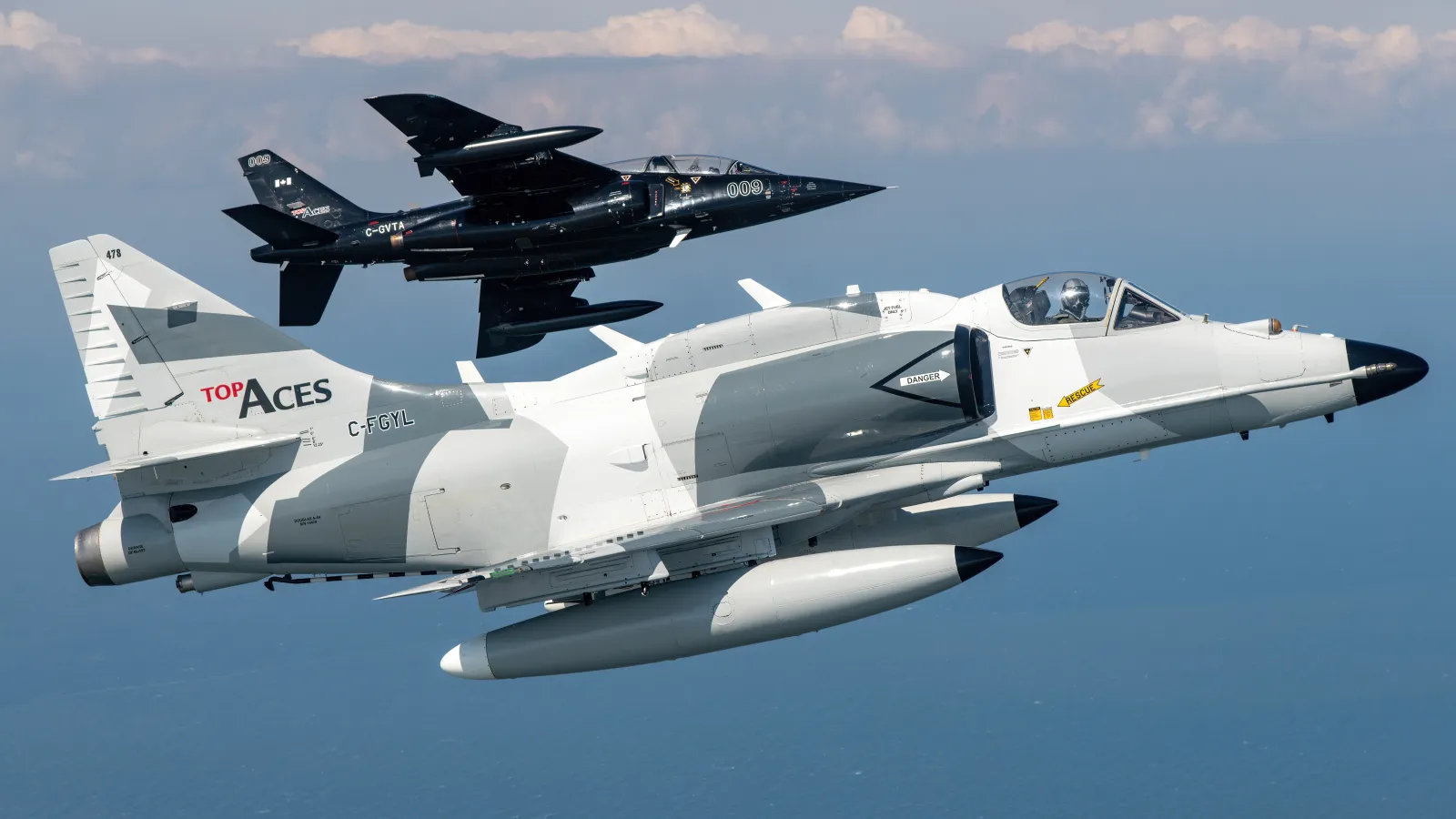
Top Aces, the Montreal-based private combat-training operator, has secured a contract worth up to €450 million to deliver advanced adversary air (Red Air) training to the French Armed Forces. The deal, awarded by the French Ministry of the Armed Forces and Veterans through a consortium led by SDTS and including Babcock France, will run for an initial six years with an option to extend by two further years. It is the company's second nine-figure European contract in 2026, following a renewed ten-year deal worth up to €420 million with Germany's Bundeswehr signed earlier this year.
Red Air training involves private operators flying aggressor aircraft that simulate the tactics and electronic signatures of hostile near-peer threats, freeing frontline military squadrons from having to dedicate their own combat aircraft and pilots to the role. Under the French contract, Top Aces France will deploy upgraded A-4N Skyhawk Advanced Aggressor Fighters alongside Alpha Jet aircraft across French territory, putting realistic threat replication within reach of the French Air and Space Force, the French Navy, and the French Army simultaneously.
A privatised model going continental
The scale and pace of Top Aces' European expansion reflects a broader structural shift in NATO procurement thinking. Historically, Red Air was an internal military function; the growing complexity and cost of simulating advanced-threat aircraft has made the commercial outsourcing model increasingly attractive to defence ministries working under constrained budgets. Top Aces operates the world's largest fleet of commercially owned tactical fighter aircraft, including the only privately held F-16s, giving it a hardware and operational credibility that few rivals can match.
"This contract represents an important milestone for Top Aces in France and reinforces our long-term commitment to Europe," said Didier Toussaint, Group President – International at Top Aces. The language is diplomatic, but the strategic intent is clear: the company is methodically locking in long-duration sovereign contracts across NATO's European tier, building a recurring-revenue base that resembles infrastructure more than traditional defence services.
Convergence: capital, sovereignty, and the readiness economy
The convergence angle for cross-sector investors is the collision between sovereign defence procurement and the private-capital model that underpins companies like Top Aces. Founded by veteran Royal Canadian Air Force pilots in 2000, the company sits at the intersection of privatised military capability and alliance readiness spending, a category that is attracting renewed attention from defence-focused private equity and infrastructure funds as NATO members ramp expenditure toward and beyond the 2% of GDP target.
Two contracts totalling up to €870 million across France and Germany within a single calendar year suggests that European defence ministries are not merely experimenting with the outsourced Red Air model; they are embedding it. For capital allocators watching the defence-tech space, the more instructive signal may be the contract duration: six-to-ten-year terms with extension options are the kind of visibility that infrastructure investors price very differently from programme-of-record defence contracts, which carry cancellation risk tied to political cycles.
The broader second-order effect touches aerospace manufacturing and sustainment. Maintaining and upgrading a fleet of A-4N Skyhawks and Alpha Jets to replicate modern threat profiles requires continuous avionics and sensor integration work, creating a downstream supply chain opportunity for European aerospace MRO (maintenance, repair and overhaul) providers. As NATO allies accelerate operational readiness investments, the commercial Red Air model could serve as a template for other training domains, ground-based electronic warfare simulation and maritime threat replication among them, drawing further private capital into a readiness economy that European governments increasingly cannot fund alone.